
Chains, brake pads, tyres, lube and sealant all wear out. That is normal. What costs you money is leaving them too long, because a worn part damages the parts around it. A tired £25 chain can take a £50 cassette with it.
This guide runs from the cheapest consumable to the most expensive. For each one, we tell you when to replace it, what we recommend, and why.
Prices and stock are correct as of 30 September 2026. These change. Click through to any product page for the live price.
Scotland is not dry or moderate. Typical lifespan figures assume dry, gentle conditions. Wet riding cuts the life of chains, cassettes, pads and bearings by 30% to 50%, because grit and water grind away at moving parts. Our advice for year-round riders is to cut every lifespan figure in this guide by a third.
E-bikes wear parts faster again. A mid-drive motor sends all its power through the chain, up to 150Nm on a DJI Avinox M2S bike, and the extra weight works the brakes and tyres harder. E-MOUNTAINBIKE Magazine snapped four chains while testing the new Avinox motors, mostly when shifting across several gears at once under load. Read more in our e-bike motors guide.
1. Tubeless sealant
Replace: top up every three to six months, whether you ride or not.
Sealant dries out inside the tyre over time. Dried sealant seals nothing, and you only find out when you puncture. Put a reminder in your phone for spring and autumn. BikeRadar gives the same three to six-month interval, and suggests a full clean-out every 12 to 18 months.
Our pick: Stans NoTubes is the one we would pick for most riders. It is cheap, it is easy to find, and it seals the small holes you get on Scottish trails. Peaty's HoleShot costs a little more and uses fibres to plug bigger cuts.
- Stans NoTubes Tubeless Sealant, from £3.
- Peaty's HoleShot BioFibre Tubeless Tyre Sealant, from £6.39.
2. Chain lube
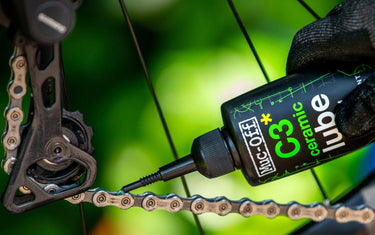
Replace: clean and lube every 200 to 300 miles, or after every wet ride.
For most of the year in Scotland, use a wet lube. Dry lube is fine for dusty summer trails, but it washes off in the first puddle. Always degrease and dry the chain first. Putting fresh lube on a dirty chain just makes grinding paste. MBR recommends the same approach for winter riding.

Our pick: Peaty's Wet Weather Lube for everyday riding. It costs little and stays on in the rain. If you would rather lube less often, Muc-Off C3 costs more but lasts longer between applications.
- Peaty's LinkLube Wet Weather Lube, from £3.
- Muc-Off Wet Lube, from £3.99.
- Muc-Off C3 All Weather Ceramic Lube 120ml, £18.40.
3. Brake pads
Replace: usually every 1,000 to 2,500 miles, sooner on heavy bikes and long descents. Change them when the pad material is worn close to the height of the metal spring behind it.
There are two main types. Sintered pads are made from metal. They last longer and work better in wet, muddy conditions, but they can be noisy. Resin pads are quieter, but wear fast in the wet. For Scottish riding, we recommend sintered pads, and on a 22kg to 25kg e-mountain bike we would not use anything else. BikeRadar and off-road.cc reach the same conclusion.
One warning. Never spray chain lube near your brakes. Oil soaks into pads and they cannot be saved.

Our pick: match the pad to your brake. If you ride a Whyte Karve, it has SRAM Maven brakes, and the Galfer pads fit.
- Galfer Disc Brake Pads for SRAM Maven, from £10.
- Hope V4 Disc Brake Pads E-Bike Compound, £15.
- Shimano G04S Sintered Disc Brake Pads, £16.79.
Not sure which pads fit? Call us on 01563 526800 with the name of your brake.
4. Disc rotors
Replace: usually every 10,000 to 20,000 miles, or when the rotor is below its minimum thickness.
Rotors wear slowly, so most riders forget about them. Check yours once a year. The minimum thickness is usually stamped on the rotor. BikeRadar notes that Shimano rotors start at 1.8mm and should be replaced at 1.5mm. A thin rotor gets hot faster and can warp or crack.
Our pick: the Shimano SM-RT66 is a solid, low-cost replacement for most 6-bolt hubs. The Magura Storm HC is thicker and suits heavier bikes and long descents.
- Shimano SM-RT66 Zee/SLX 6-Bolt Rotor, from £18.39.
- Magura Storm HC Rotor 6-Bolt, £22.94.
5. Chains
Replace: when a chain wear tool says so. On 11 and 12-speed bikes, that is at 0.5% wear. On 6 to 10-speed bikes, it is at 0.75%. For most riders, that means every 2,000 to 3,000 miles, or as little as 500 to 2,000 miles on a mid-drive e-bike.
This is the part that matters most. A worn chain grinds the cassette and chainrings into a matching worn shape. Replace chains on time and one cassette will outlast two or three of them. Leave it and you replace both at once. Do not wait for the gears to skip. By then, the damage is done. BikeRadar uses the same wear limits and also says mileage is not a reliable guide. So measure it.

On an e-bike, use an e-bike rated chain and ease off the pedals for a moment when you change gear. Match the chain to your drivetrain, because SRAM T-Type and Shimano 12-speed chains are not interchangeable.
Our pick: the KMC E12 EPT for e-bikes and wet riding. It is e-bike rated and has an anti-rust coating. For a normal 12-speed mountain bike, the KMC X12 is good value. And buy a chain wear tool. The Unior Chain Wear Indicator costs £19.99 and pays for itself the first time it saves a cassette.
- KMC X12 12-Speed Chain, £25.
- KMC E12 EPT 12-Speed Chain, £37.69.
- Shimano CN-M8100 XT 12-Speed Chain, £39.99.
- SRAM GX T-Type Eagle 12-Speed Chain, £44.
6. Tyres
Replace: usually every 1,000 to 2,000 miles, or when the tread blocks are rounded or torn, or the casing is cut. The rear wears two to three times faster than the front.
Worn tyres are the easiest thing to spot and the most often ignored. Rounded tread blocks lose grip in the wet and on roots, which is most of Scotland. A good setup is a grippy, soft tyre on the front for steering and a harder-wearing tyre on the rear. On an e-mountain bike, choose a tyre with an e-bike rating, such as Schwalbe's E-50. The casing is stronger for the extra weight and power.

Our pick: the Schwalbe Magic Mary on the front for mud, with the Tacky Chan on the rear. Both are e-bike rated. The Michelin Wild Enduro is the choice if your bike runs a 27.5" rear wheel.
- Schwalbe Tacky Chan Super Gravity 29" E-50, £47.99.
- Michelin Wild Enduro MH Racing Line 27.5", £50.
- Schwalbe Magic Mary Trail Pro Radial 29" E-50, £57.99.
7. Cassettes
Replace: every 5,000 to 8,000 miles, if you replace your chains on time.
The cassette is the most expensive part here, and the easiest to protect. If a cassette wears out early, a chain was almost always left too long. Once it is worn, a new chain will skip on it and wear out faster too, so you have to replace both.
Our pick: the Shimano Deore CS-M5100 for 11-speed Shimano bikes. For 12-speed bikes, the cassette has to match your drivetrain, so call us and we will check which one fits.
- Shimano CS-M5100 Deore 11-Speed Cassette, from £51.99.
Everything at a glance
Typical figures for a bike ridden in dry, moderate conditions, from the cheapest part to the most expensive. Prices are the lowest we stock.
| Part | Replace | Price from | What wears it out |
|---|---|---|---|
| Tubeless sealant | Every 3 to 6 months | £3 | Time, not distance |
| Chain lube | Every 200 to 300 miles, or every wet ride | £3 | Rain, mud, washing |
| Disc brake pads | 1,000 to 2,500 miles | £10 | Mud, long descents, bike weight |
| Disc rotors | 10,000 to 20,000 miles | £18.39 | Hard braking |
| Chain | 2,000 to 3,000 miles | £25 | Wet riding, grit, poor lubrication |
| Mountain bike tyres | 1,000 to 2,000 miles | £47.99 | Rock, roots, soft rubber |
| Cassette | 5,000 to 8,000 miles | £51.99 | Running a worn chain |
What it costs per year
For a rider covering 3,000 miles a year in wet UK conditions, budget about £90 to £235 a year for parts. That covers one or two chains, one or two sets of brake pads, a rear tyre, and lube and sealant. Add a cassette, rotors and a front tyre every second year. On a hard-ridden e-mountain bike, expect to be at the top of that range.
A simple routine
Every ride: check tyre pressure, squeeze both brake levers, and check nothing is loose.
Every month: clean and lube the chain, check chain wear, and look at your brake pads.
Every three months: deep clean the drivetrain and top up tubeless sealant.
Once a year: check rotor thickness, replace cables, and book the bike in for a full service.
Frequently asked questions
How often should I replace my bike chain?
Check it with a chain wear tool every 500 miles. Replace an 11 or 12-speed chain at 0.5% wear, and a 6 to 10-speed chain at 0.75%. On a normal bike that is usually 2,000 to 3,000 miles. In wet Scottish conditions, expect about a third less. On a mid-drive e-bike, it can be as little as 500 to 2,000 miles.
How long do disc brake pads last?
Usually 1,000 to 2,500 miles. They wear faster on heavy e-bikes, on long descents and in mud. Sintered pads last longer than resin pads and work better in the wet.
Do e-bikes wear out parts faster?
Yes. A mid-drive motor sends all its power through the chain and cassette, and the extra weight works the brakes and tyres harder. Use e-bike rated chains, pads and tyres, and expect to replace them more often.
Not sure what needs replacing? Bring your bike in and we will check it while you wait. If you would rather leave it with us, we also offer full workshop servicing. Visit us at Ayr Road, Kilmarnock, KA1 5LF, or call 01563 526800. We are open seven days.